
Career Advice
Teaching jobs in Cyprus 2026: salaries, schools and how to qualify
Cyprus has one of the most active English-language teaching markets in the eastern Mediterranean — international schools, language institutes, private tutoring and state positions all represent viable career paths.
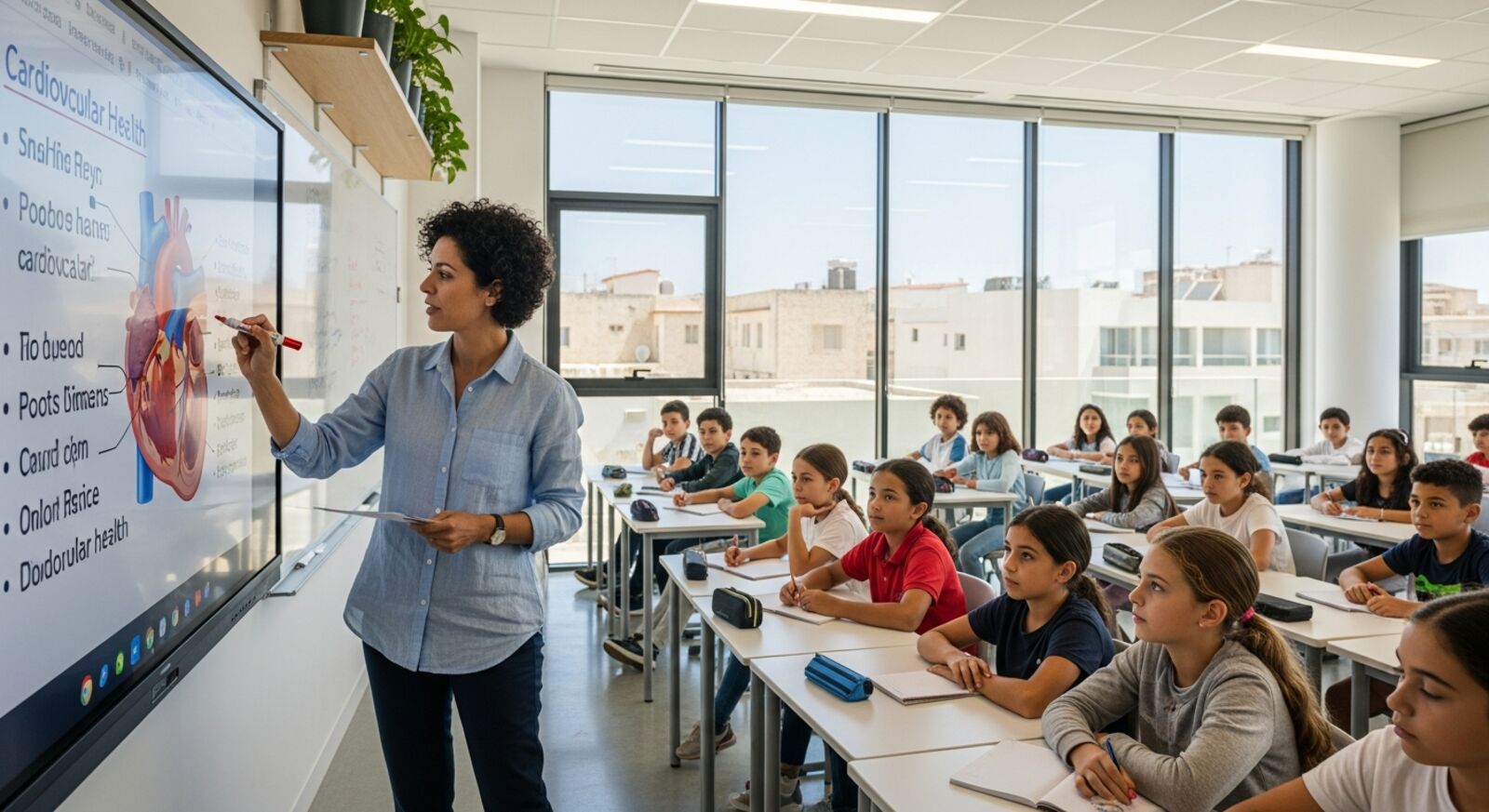
Teaching is one of the most consistent employers of international professionals in Cyprus. The island has a well-developed private and international school sector, a large private language institute (frontistírio) market serving Cypriot families who supplement state education with private English tuition, and a growing English-medium university sector. For qualified teachers — particularly those with UK, US, or Australian qualifications — Cyprus is a straightforward market to enter with competitive salaries relative to the cost of living.
Sources: Cyprus Ministry of Education, Sports and Youth (MOEC) 2026 recruitment data; Cyprus Private Schools Association; International Schools Consultancy (ISC) Research Cyprus data; Council of International Schools (CIS); active teaching job listings on Cyprus Job Finder; Eurostat education employment statistics Cyprus 2025.
The four main employment routes
1. International schools
Cyprus has a cluster of established English-medium international schools, concentrated in Limassol and Nicosia, with smaller campuses in Larnaca and Paphos. Most follow the Cambridge IGCSE / A-Level curriculum or the International Baccalaureate (IB); a smaller number follow the US Common Core or national curricula from their founding country.
Key names include: The English School (Nicosia) — the oldest and most academically prestigious; Pascal Private School; The Heritage Private School; American Academy (Larnaca); and several newer IB-authorised schools that have opened in Limassol in the last five years to serve the influx of international professional families.
Salary ranges (international schools, gross monthly 2026):
| Role | Salary range |
|---|---|
| Primary / class teacher | €2,200–€3,200 |
| Secondary subject teacher | €2,400–€3,500 |
| Head of department | €3,200–€4,800 |
| Deputy head / vice principal | €4,000–€6,500 |
| Principal / headteacher | €6,000–€10,000+ |
Many international school packages include additional benefits: health insurance, housing allowance or school-owned accommodation, relocation support, and flights home annually for contract teachers. These benefits can add €500–€1,200/month in effective compensation beyond the stated salary.
Qualifications typically required: A recognised Bachelor of Education (B.Ed.) or a degree plus Postgraduate Certificate in Education (PGCE) or equivalent (Australian Dip.Ed., US state teaching licence). International Baccalaureate experience or IB certificate is strongly preferred by IB World Schools. Membership of the Chartered College of Teaching or equivalent professional body is valued.
2. Private schools (Greek-Cypriot curriculum with English stream)
Private schools operating the Cyprus Ministry of Education curriculum — but offering an enhanced English-language programme alongside Greek instruction — are significant employers of English-language teachers. These are typically less expensive than full international schools and serve primarily local professional families.
Salaries here are somewhat lower than international schools:
- English teacher (primary or secondary): €1,700–€2,600 gross monthly
- Senior teacher / pastoral lead: €2,500–€3,800 gross monthly
Benefits packages are less comprehensive than international schools but positions are often more stable, with longer contract terms and closer integration into the local community.
3. Private language institutes (frontistíria)
The frontistírio — private language institute — is a cornerstone of Cypriot educational culture. Almost every Cypriot child attends a frontistírio for English tuition after school hours. There are estimated to be over 700 registered language institutes across Cyprus, making this the largest single segment by employer count in the education sector.
Positions here are typically part-time or afternoon/evening, since classes run after the state school day. A full-time equivalent role is usually assembled from teaching at multiple institutes or combining institute work with private tutoring.
TEFL/CELTA is the minimum standard for most frontistíria. A CELTA (Certificate in English Language Teaching to Adults, awarded by Cambridge Assessment English) is the industry-recognised gold standard and significantly improves both employability and rate of pay.
Pay rates:
- Hourly teaching rate: €12–€25/hour depending on qualification and location
- Full-time equivalent (30 contact hours/week): approximately €1,400–€2,200 gross monthly
Frontistíria are not required to offer employment contracts in the same way as schools, and some positions are structured as self-employed teaching engagements. Workers should clarify employment status before accepting, as it affects social insurance contributions and employment rights.
4. State sector (public schools)
Cyprus state schools teach predominantly in Greek. The Ministry of Education recruits English-language teachers for the state sector, though positions for non-Greek-speaking teachers are rare outside specific language programmes.
For Cypriot-qualified teachers: The public sector offers structured pay scales (significantly lower than international schools in absolute terms but with exceptional job security and pension), the 13th-month salary, and a progressive increment system. State teacher salaries in 2026 range from approximately €1,200 to €1,800 gross monthly at various scale points.
For foreign-qualified teachers: Entry into the state sector requires recognition of qualifications by the Cyprus Pedagogical Institute and, typically, Greek language proficiency. This limits state-sector access for most newly arrived international teachers.
5. Higher education
Cyprus has five accredited universities (University of Cyprus, Cyprus University of Technology, Open University of Cyprus, European University Cyprus, and University of Nicosia) plus several private colleges. English is the medium of instruction at most programmes.
Lecturer and visiting faculty positions exist at English-medium institutions. Terms vary widely — visiting lecturers may be paid per course (typically €800–€2,000 per course per semester); full-time academic positions in 2026 pay approximately €2,500–€5,500 gross monthly depending on rank and institution.
Qualification recognition in Cyprus
The Cyprus Pedagogical Institute (PI) under the Ministry of Education handles recognition of foreign teaching qualifications for employment in private schools and, where applicable, the state sector.
Recognition is primarily relevant for:
- Teachers applying to private schools that require a formal teaching qualification (as opposed to a subject degree + TEFL)
- Teachers seeking access to the state sector
For most international school appointments, the school's own academic board assesses qualifications — official PI recognition is less commonly required and the international reputation of the awarding institution (Cambridge, Oxford, a recognised US university) carries significant weight.
DBS / criminal background check: All teachers working in Cyprus, regardless of sector, should expect to provide a police clearance certificate from their home country. For UK teachers, an enhanced DBS (Disclosure and Barring Service) check is standard. For other nationals, a notarised and apostilled criminal record certificate from the relevant authority is typically required.
Private tutoring: the informal supplement
Private tutoring is widespread in Cyprus and represents a meaningful income stream for established teachers. Rates in 2026:
- One-to-one tuition (English, maths, sciences): €20–€45/hour depending on level and location
- A-Level specialist tutoring in Limassol or Nicosia: €35–€60/hour
- IB preparation (HL subjects, extended essay): €45–€75/hour
Many teachers in Cyprus combine a part-time frontistírio role with a private student base to build a total income of €2,000–€3,500/month — comparable to a full-time international school position, but with significantly more scheduling flexibility.
Tax position for private tutors: freelance tutoring income is taxable in Cyprus and should be declared. Self-employed individuals pay social insurance contributions (14.6% of declared income in 2026) plus GeSY (4% of declared income). Cyprus's generous personal tax-free allowance (€19,500/year) means low-earning tutors often pay no income tax at all.
Browse live teaching and education roles in Cyprus on the job map. For the relocation picture, see the Cyprus UK relocation guide.
FAQ
Frequently asked questions
Do I need a teaching qualification to teach English in Cyprus?
It depends on the type of school. International schools and most reputable private schools require a recognised teaching qualification — a Bachelor of Education (B.Ed.) or a subject degree plus PGCE, Dip.Ed., or state teaching licence. Private language institutes (frontistíria) typically require a minimum of a TEFL/CELTA certificate; a university degree is strongly preferred. Some smaller institutes hire without a formal teaching certificate, but pay and career prospects are significantly lower.
What is the salary for a teacher at an international school in Cyprus?
A classroom teacher at an international school in Cyprus earns approximately €2,200–€3,500 gross per month depending on level (primary or secondary) and experience. Head of department roles pay €3,200–€4,800; deputy heads €4,000–€6,500; and principals/headteachers €6,000–€10,000+. Many international schools offer supplemental benefits (health insurance, housing allowance, relocation support, annual flights) that add effectively €500–€1,200/month to the total package.
Can I teach in Cyprus without speaking Greek?
Yes, at international schools, private English-medium schools, and private language institutes. Virtually all teaching in these environments is conducted in English, and fluency in Greek is not required. For state school positions (taught in Greek) or for qualification recognition by the Cyprus Pedagogical Institute, Greek proficiency is needed. Day-to-day life in Limassol and Nicosia is very manageable in English — particularly in areas with high expat and international populations.
Is CELTA recognised in Cyprus?
Yes. The CELTA (Certificate in English Language Teaching to Adults), awarded by Cambridge Assessment English, is the most widely recognised English-language teaching qualification in Cyprus for frontistírio and language institute work. It is a Level 5 qualification on the Regulated Qualifications Framework (RQF) and is accepted as a professional teaching qualification by the vast majority of private language institutes in Cyprus.
How much can I earn from private tutoring in Cyprus?
Private tutoring rates in Cyprus in 2026 range from €20–€45/hour for one-to-one English and core subject tuition, rising to €45–€75/hour for IB Higher Level or A-Level specialist preparation in Limassol or Nicosia. A teacher with an established private student base of 15–20 weekly hours can earn €1,500–€3,000/month purely from private tutoring. Income must be declared as self-employment income and is subject to Cyprus social insurance contributions (14.6%) and GeSY (4%), with the €19,500/year tax-free allowance applying.
About the author
Barry Davies
Founder, Cyprus Job Finder
Barry Davies is the founder of Cyprus Job Finder and the wider Jobs.com.cy network. He has spent over a decade tracking the Cyprus employment market first-hand — from Limassol's forex and technology sector to seasonal tourism hiring across the island. Every guide here is written from the network's live listing data and on-the-ground editorial research, not recycled from elsewhere.
Keep reading
Related articles

Relocation
Relocating to Cyprus from the UK in 2026: the honest guide
Visas, banking, driving licences, healthcare, schools and what it actually costs to move — from someone who has done it.
12 min read

Career Advice
English-speaking jobs in Cyprus 2026: industries that don't need Greek
You don't need to speak Greek to work in Cyprus — entire industries run in English. Here's the realistic 2026 list of sectors and roles where English-only candidates are routinely hired, and the ones where Greek really is essential.
7 min read

Salary Insights
Cost of living in Cyprus 2026 vs salary: can you actually afford Limassol?
A line-by-line monthly budget for the four major Cyprus cities in 2026 — rent, utilities, groceries, transport, healthcare — and what salary you actually need to live well, not just survive.
8 min read